The Blue Light Over Sweet Daves Chair in the Hateful Eight
Major plot spoilers ahead.
Unless you live near the rarest of things — a well-funded theater — you may not be familiar with the name Martin McDonagh. In the late 1990s and early 2000s, the playwright was the Quentin Tarantino of Broadway, penning a series of award-winning plays containing that familiar mix of pop culture, racy language, methodical tempo, and violence. Specifically, gore. Specifically, climactic scenes in which actors' heads, under the extreme pressure of a close range firearm, detonate into pulpy red goo. One McDonagh play, The Lieutenant of Inishmore, features an onstage cat explosion. When staged by a particularly gutsy theater, squibs launch sticky giblets onto the front row of rich, elderly theatergoers, like a high brow spin on Gallagher's watermelon routine.
By the mid-2000s, McDonagh's prestige helped him greenlight a couple of films, most memorably In Bruges. The marketing promoted In Bruges as what McDonagh fans and haters alike assumed the writer had been angling to make all along: a cheap but compelling Tarantino clone. But when McDonagh got his shot at Tarantino's medium, he pivoted and made a patient and sincere character study of a hitman (Colin Farrell) paralyzed by guilt. In Bruges was a personal film that, for sometimes worst but mostly better, lacked both Tarantino's capital-M Messages and capital-C Cynicism.
A play with exploding cats
I mention all of this because on Christmas Day in a select crop of theaters — and at a couple thousand more theaters in the coming weeks — Tarantino gave to the world his latest film, The Hateful Eight. Tarantino, almost two decades after McDonagh hit the stage, is now riffing on the playwright. I would question the intentionality of the grift, but that would insult Tarantino's obsession with a genre he defined. The explosive body parts, the climactic sequence in which the floor is covered in blood, the economy of space and time: The Hateful Eight is a reflection of a reflection, and the result is distortion.
Like In Bruges, the whipcrack marketing of a western showdown doesn't match the picture. The Hateful Eight is a play about men reckoning with their history, while also humiliating and brutalizing the woman that connects them. It's not a showdown; it's protracted torture show set in a one-room cabin with a set design meant to project to the rear seats. Its large props are lit with sharp white light, like potential weapons on a murder mystery set.
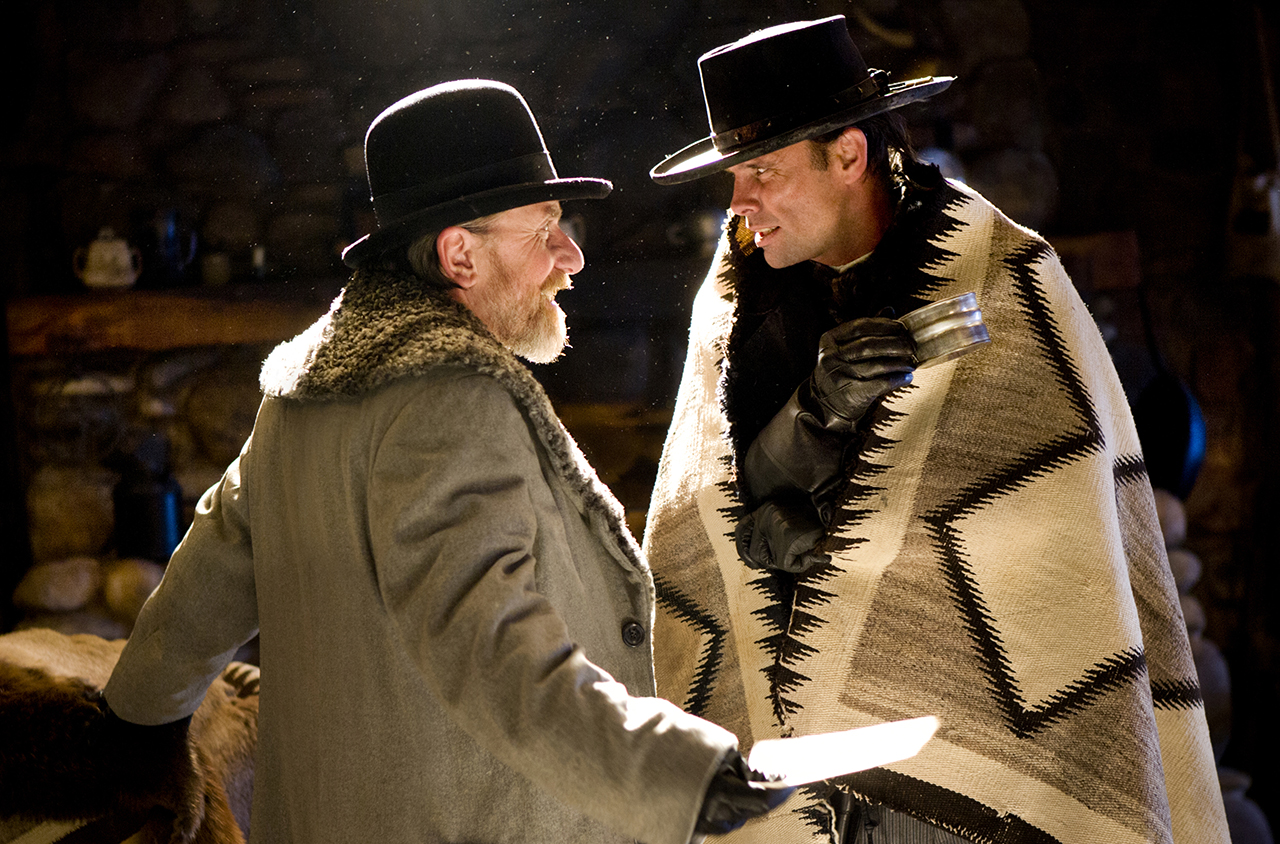
The film opens with the lone sequence outside the cabin grounds, a stagecoach's trip through the snowy Wyoming mountainside. A bounty hunter named John Ruth (Kurt Russell) and his captive, a beaten Daisy Domergue (Jennifer Jason Leigh), collect a Union Major turned bounty hunter (Samuel L. Jackson) and a Southern Rebel turned local sheriff (Walton Goggins), all of whom are trying to reach a haberdashery before a blizzard gets the best of them.
Once Ruth's stagecoach reaches its mark, all the pieces are already in place for an ultra-violent, but unapologetically traditional play. It echoes the tavern scene from Tarantino's 2009 Inglourious Basterds, a tense showdown that pivots on concealed identities. The scene is cited often in critical conversations of Tarantino's maturation as a writer, but the liberal spreading of what works as a 30-minute chunk across a feature film turns the substance into a watery mess that slips through your fingers if you try to grab on.
The Hateful Eight is a play without substance
As a play, The Hateful Eight is sloppy — a series of lanterns hung on moments in the first act to remember when they pay off in the third. The single jelly bean on the ground, the odd rugs covering the chair by the fireplace, the hitchhikers — a black Union leader and Confederate sympathizer — we're told can't possibly have a thing in common, so we know to be dumbstruck when that change lands with a thwop in the film's conclusion.It's like Tarantino had never heard of Chekhov until he Googled "Cool ways to use a gun."
The film is at once shaggy and structurally rote, and in these confined quarters, one can't help but marvel at how McDonagh does Tarantino better than Tarantino himself. Though he's spent his career paying artful homage, for the first time, this is Tarantino as a wannabe.

If you haven't seen a play since high school, that's fine, the memory will serve us well. At three hours, The Hateful Eight has the stilted swagger of a self-impressed community theater director, mangling time with dramatic pauses, loaded winks, and farcical accents we're supposed to believe contain meaning. And like high schoolers away from the stage, The Hateful Eight's characters punctuate with swears and slurs intended to shock.
Tarantino previously justified a relentless deployment of offensive language by awarding victims the final laugh. A gang of Jews kill Hitler. A freed slave kills plantation owners. The victims of this film alternate between non-whites and women. But when they laugh, they're struck down. The Major gets castrated by a bullet, the "Mexican" has his head popped, and Jennifer Jason Leigh's Daisy Domergue is beaten within an inch of her physical life, and then the attacks get mental. There is no justice or catharsis here, just bad people doing bad things.
Don't get me wrong, other things happen over three hours. Men die, though their deaths, while gruesome, are comparably quick. And there's a big twist involving a big name actor that we see coming because his name gets prize billing in the opening credits, informing us that, despite the title, a ninth man is in waiting. But all of the turns, reveals, shifts in alliance, and third act surprises don't amount to anything more than insipid excuses to fill the small cabin with blood, guts, profanity, and — living up to the title — hatred.
What Tarantino's work has always shared with stage plays, the thread connecting him to Great American Dramas, is a desire to pull back the curtain on some shared, unspoken dread. When even Oscar contenders whitewash and sterilize their subjects, Tarantino swings in the other direction. His films are parlor tricks, disarming you with a tawdry left hand, while clocking up his statement in the right. Even Shakespeare knew the power of blood lust.
The statement never comes in The Hateful Eight, unless it's buried in all the entrails.
Maybe this is a film about how when law fails its citizenry, a more Biblical law abides, and that maybe these two laws aren't all that different. In which case, Tarantino undercuts the message with over-the-top racism and a dearth of context. Or I suppose there's a reading of this film in which the men are embodiments of post-war racial anxiety, of Northern righteousness and Southern bitterness over terms of unconditional surrender — a military term for when the victorious side offers no guarantees to the loser.
The film is unclear on what it intends to say
That's where the film ends, with Domergue — covered in blood from head to shot-off toe — begging for her life, and two men, all but dead, hanging her anyway. Those men, the hitchhikers, Confederate and Union, sheriff and bounty hunter. We finally learn what will bring them together: a lethal hatred of women. And the sides, we're led to believe, are clear cut. Men are the winners, and women, the losers.
I'm left wondering who the victim of this film is. Who does Tarantino think deserves the last laugh? I hate to take the last shot at face value, but how can you not? There it is, two men, stringing up a woman, laughing their guts out. The joke's on her.
I know why The Hateful Eight is a film, and not a play though. Audiences wouldn't react quite so kindly if they had to watch a real woman on the stage, her neck snared in the noose. We'd have no editing to cut away from the horror, reminding the audience to smile.
Source: https://www.theverge.com/2015/12/31/10695780/the-hateful-eight-tarantino-criticism
Belum ada Komentar untuk "The Blue Light Over Sweet Daves Chair in the Hateful Eight"
Posting Komentar